

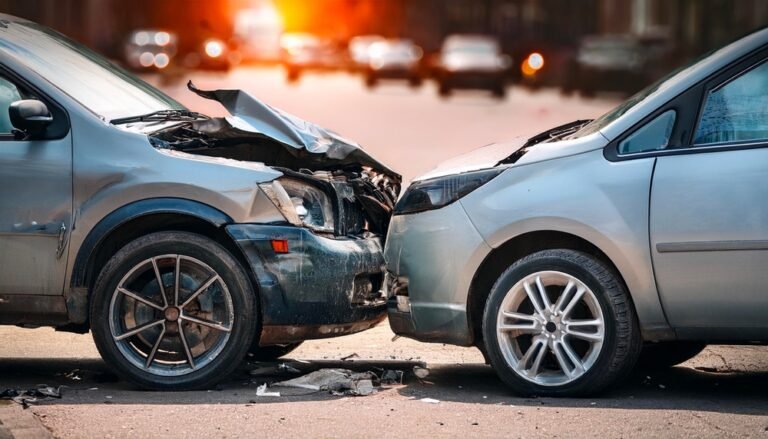
The cause of your crash is not just background detail. In this region it can decide whether you recover anything at all.
Most crashes in this area are not freak events. They come from a short list of causes that repeat constantly, and the roads around Tysons make several of them worse than they would be elsewhere.
Knowing which one caused your crash matters for two reasons. It is the foundation of proving the other driver was responsible, and it is the first place an insurance company will look for a reason to blame you instead.
Distracted driving
Phones are the obvious version, but distraction covers navigation systems, food, passengers, and anything else that pulls a driver’s attention off the road.
It is a particular problem in stop and go traffic on the Beltway and I-66, where drivers assume the pace is slow enough that a glance down is harmless. At thirty miles per hour, three seconds is more than a hundred feet.
Speeding and aggressive driving
Speed does two things. It shortens the time a driver has to react, and it multiplies the force of the impact.
Aggressive driving adds weaving, tailgating, and cutting across lanes to make an exit. The stretch of I-495 through Tysons and the merges around the I-66 interchange produce a steady volume of these crashes.
Following too closely
Rear-end collisions are among the most common crashes on the road, and they cause a large share of neck and back injuries.
Liability in a rear-end crash is often clearer than in other collisions, but do not assume it is automatic. Insurance companies still look for arguments, such as claiming the front driver stopped suddenly for no reason or had a brake light out.
Unsafe lane changes and merging
Blind spot collisions, merges into occupied lanes, and drivers crossing multiple lanes at once.
This is a signature crash type in Northern Virginia because of how many highway interchanges require a driver to cross several lanes in a short distance. Short merge lanes and heavy volume are a bad combination.
Running red lights and failing to yield
Intersection crashes tend to produce more severe injuries than rear-end collisions because the impact often lands on the side of the vehicle, where there is less structure between the occupant and the other car.
Left turns across oncoming traffic are a frequent version of this. So are drivers pulling out of shopping center exits without yielding, which is a constant along Route 7 and Route 50.
Impaired driving
Alcohol and drugs, including prescription medications that carry driving warnings.
These crashes concentrate late at night and on weekends, and they are often more severe because an impaired driver brakes late or not at all. If a driver is charged criminally, that proceeding is separate from your injury claim, though what comes out of it can be relevant.
Drowsy driving
Underreported, because it rarely appears on a police report. A driver who drifts out of a lane or fails to brake for stopped traffic may have been asleep for a few seconds.
It is a recurring factor in commercial vehicle crashes, where drivers are working long shifts and hours-of-service records can become important evidence.
Weather and road conditions
Rain, ice, standing water, and poor visibility. Weather rarely excuses a crash on its own, because drivers are expected to adjust to conditions. Driving the speed limit on ice can still be too fast.
Potholes, missing signage, and poorly marked construction zones can also contribute, and those situations sometimes involve a party other than the driver.
Why the cause matters so much here
Virginia, Maryland, and DC follow contributory negligence. Under that rule, if the insurance company can show you were even slightly responsible for the crash, your claim can be barred completely rather than reduced.
That is why the cause is not a side detail. Establishing clearly what the other driver did wrong is half the work. Making sure there is no opening to argue you contributed is the other half.
It is also why what you say at the scene carries so much weight. An offhand comment about being in a hurry or not seeing the other car can become the entire argument against you.
How the cause gets proven
Rarely by one thing. Usually by several stacked together:
The police report and any citations issued
Photographs of the vehicles, the damage patterns and the scene
Security or traffic camera footage, which is often recorded over within about thirty days
Witness statements taken while memories are fresh
Phone records, in cases where distraction is suspected
Vehicle data, and for commercial trucks, driver logs and maintenance records
Accident reconstruction in serious cases
The common thread is time. Footage gets erased, vehicles get repaired, and witnesses become harder to reach. The earlier this work starts, the more of it survives.
If you were hurt in one of these crashes
Understanding what caused your crash is where a claim starts, but proving it is a different job, and the evidence has a short shelf life.
At Paragon Law Firm, consultations are free, and you talk to an attorney. If we take your case, you owe nothing unless we recover money for you.
We represent injured people in Virginia, Maryland, and Washington DC.
Paragon Law Firm
8233 Old Courthouse Rd, Tysons, VA
Call for a free and confidential consultation.


